Closing a 28% attribution leak in MUSINSA's creator coupon flow
Closing a 28% attribution leak in MUSINSA's creator coupon flow
Rebuilt how customers claim and use curator coupons on MUSINSA, achieving 91.3% direct-path adoption and 45.38% coupon GMV routed through the redesigned flow.
Rebuilt how customers claim and use curator coupons on MUSINSA, achieving 91.3% direct-path adoption and 45.38% coupon GMV routed through the redesigned flow.

Platform
Mobile/PC
My role
Design Lead
Timeline
Jan 2026 -
Mar 2026
Team
1 Product Designer (me)
1 Project Manager
2 Front-End Engineer
2 Back-End Engineer
Overview
Overview
Curator coupon UX redesign achieved 91.3% direct-path visits and 45.38% coupon GMV attribution
Curator coupon UX redesign achieved 91.3% direct-path visits and 45.38% coupon GMV attribution
Starting from a 28% attribution leak surfaced by usage data and curator interviews, the project redesigned the coupon claim journey. Designing it to never leave the entry path drove the visit and GMV attribution results above.
Starting from a 28% attribution leak surfaced by usage data and curator interviews, the project redesigned the coupon claim journey. Designing it to never leave the entry path drove the visit and GMV attribution results above.
Impact
Impact
Coupon Page Direct Visit
91.3%
Coupon GMV Attribution
45.38%
Contribution Revenue (est.)
+39%↑
Background
Background
MUSINSA is Korea's #1 online fashion platform, with about 6.4M monthly active users and around 16M members.
MUSINSA is Korea's #1 online fashion platform, with about 6.4M monthly active users and around 16M members.


MUSINSA
6.4M
ABLY
5.4M
ZIGZAG
3.7M
QUEENIT
2.4M
Fashion App in Korea | MAU (June.2026)
In 2024, it became the first Korean fashion platform to surpass KRW 1 trillion (approx. USD 700M) in annual revenue.
In 2024, it became the first Korean fashion platform to surpass KRW 1 trillion (approx. USD 700M) in annual revenue.

Context
Context
MUSINSA Curator is MUSINSA's influencer marketing service. Brands and influencers set up a affiliate link, and MUSINSA pays commission on the sales that link generates.
MUSINSA Curator is MUSINSA's influencer marketing service. Brands and influencers set up a affiliate link, and MUSINSA pays commission on the sales that link generates.

10K+ partner brands

5K+ Curators
* How curator commerce works
Picks products, builds a curation shop
Posts the
product link in social content
Taps that link and buys on MUSINSA
Attributes the sale to that link
Pays commission on the tracked sales
Curator
Followers
MUSINSA


MUSINSA Curator is an influencer affiliate program connecting 10K+ brands with 5K+ curators, who earn commission by driving traffic and sales through personal content.
MUSINSA Curator is an influencer affiliate program connecting 10K+ brands with 5K+ curators, who earn commission by driving traffic and sales through personal content.
Situation Statement
Curator contribution was going uncounted in the system.
Curator contribution was going uncounted in the system.
Customers could copy the coupon code shown in curator content and redeem it directly via MUSINSA App > My Page > Register Coupon, without ever using the affiliate-link. On that path, the affiliate-link event is never logged.
Customers could copy the coupon code shown in curator content and redeem it directly via MUSINSA App > My Page > Register Coupon, without ever using the affiliate-link. On that path, the affiliate-link event is never logged.

Problem
Problem
Because a coupon can be used just by copying the code, real contribution never shows up in the system.
Because a coupon can be used just by copying the code, real contribution never shows up in the system.

81.8%
81.8%
“Curators who saw a need to improve the coupon system”
“Curators who saw a need to improve the coupon system”
Real contribution kept getting missed in payouts, and the complaints and requests to fix it kept coming.
Real contribution kept getting missed in payouts, and the complaints and requests to fix it kept coming.

28%
28%
“Curator coupon GMV with missing attribution”
“Curator coupon GMV with missing attribution”
Hard to read true ROI, which chips away at trust in coupon collaborations and puts re-participation at risk.
Hard to read true ROI, which chips away at trust in coupon collaborations and puts re-participation at risk.
From interviews with top and mid-tier curators/brands (Sept 2025)
From interviews with top and mid-tier curators/brands (Sept 2025)
How might we
How might we
Design a single-page journey where claiming a coupon, browsing, and buying all happen without leaving the entry path, so we don't lose either the customer or the attribution?
Design a single-page journey where claiming a coupon, browsing, and buying all happen without leaving the entry path, so we don't lose either the customer or the attribution?
Hypothesis
Hypothesis
01
In-page claiming: Keep the referral path intact
In-page claiming: Keep the referral path intact
If customers claim the coupon directly on the page reached through a curator’s affiliate link, the referral path remains intact and attribution is preserved.
If customers claim the coupon directly on the page reached through a curator’s affiliate link, the referral path remains intact and attribution is preserved.

02
Single-page journey: Reduce transitions and drop-off
Single-page journey: Reduce transitions and drop-off
If customers can claim the coupon, browse eligible items, and purchase without leaving the page, fewer transitions should reduce drop-off and improve conversion.
If customers can claim the coupon, browse eligible items, and purchase without leaving the page, fewer transitions should reduce drop-off and improve conversion.

Design Principles

Keep the entry path intact
Keep the entry path intact
Bring the claim action into the entry page so the customer never leaves the affiliate-link path. This is the direct fix for the broken tracking.
Bring the claim action into the entry page so the customer never leaves the affiliate-link path. This is the direct fix for the broken tracking.
Cut the steps
Cut the steps
Fewer steps to claim means less drop-off and less tracking breakage at the same time.
Fewer steps to claim means less drop-off and less tracking breakage at the same time.

Stay consistent with the app
Stay consistent with the app
Even though this is curator-only, I followed the MUSINSA Store coupon-box guidelines so it feels familiar and is easy to learn.
Even though this is curator-only, I followed the MUSINSA Store coupon-box guidelines so it feels familiar and is easy to learn.

Design Solution
01
Entry point : How to prompt the coupon claim.
Entry point : How to prompt the coupon claim.
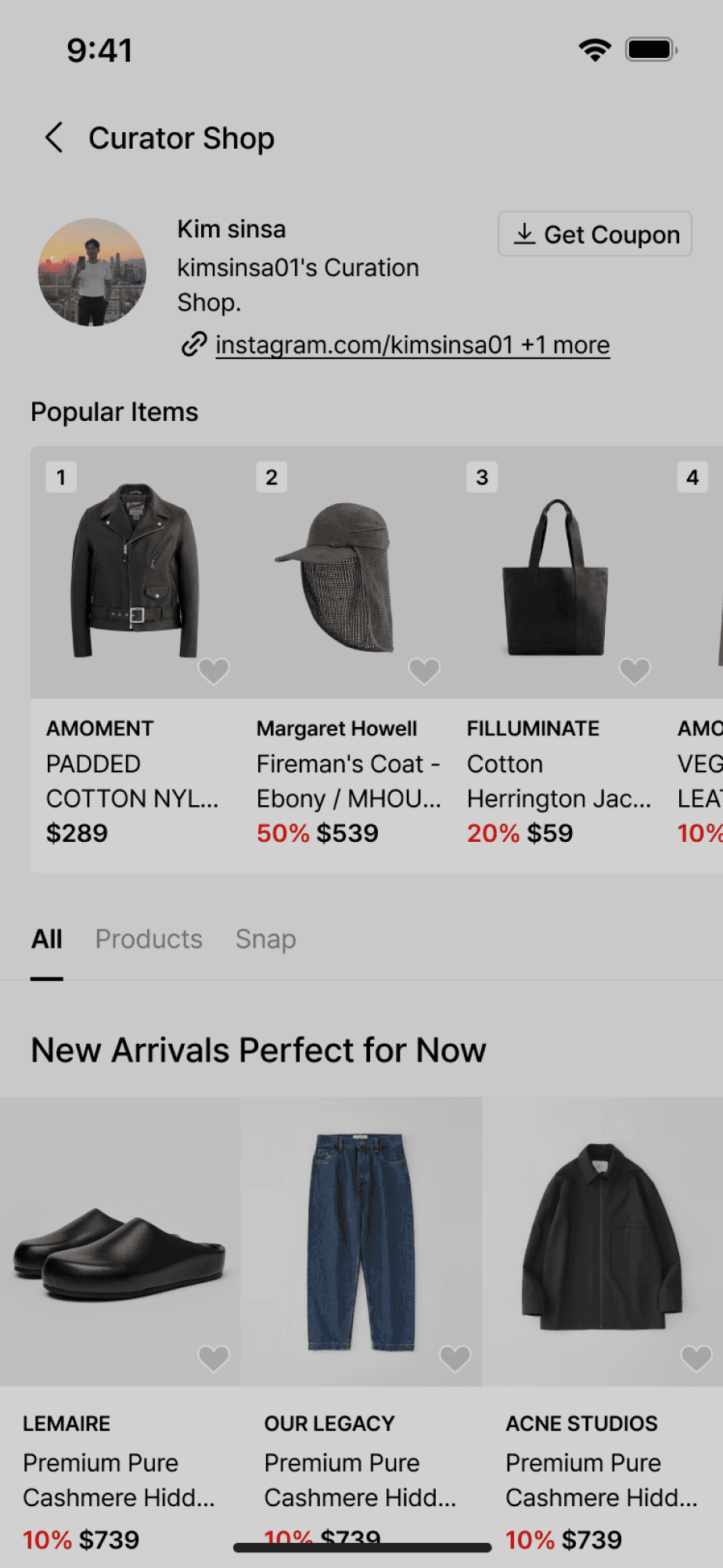
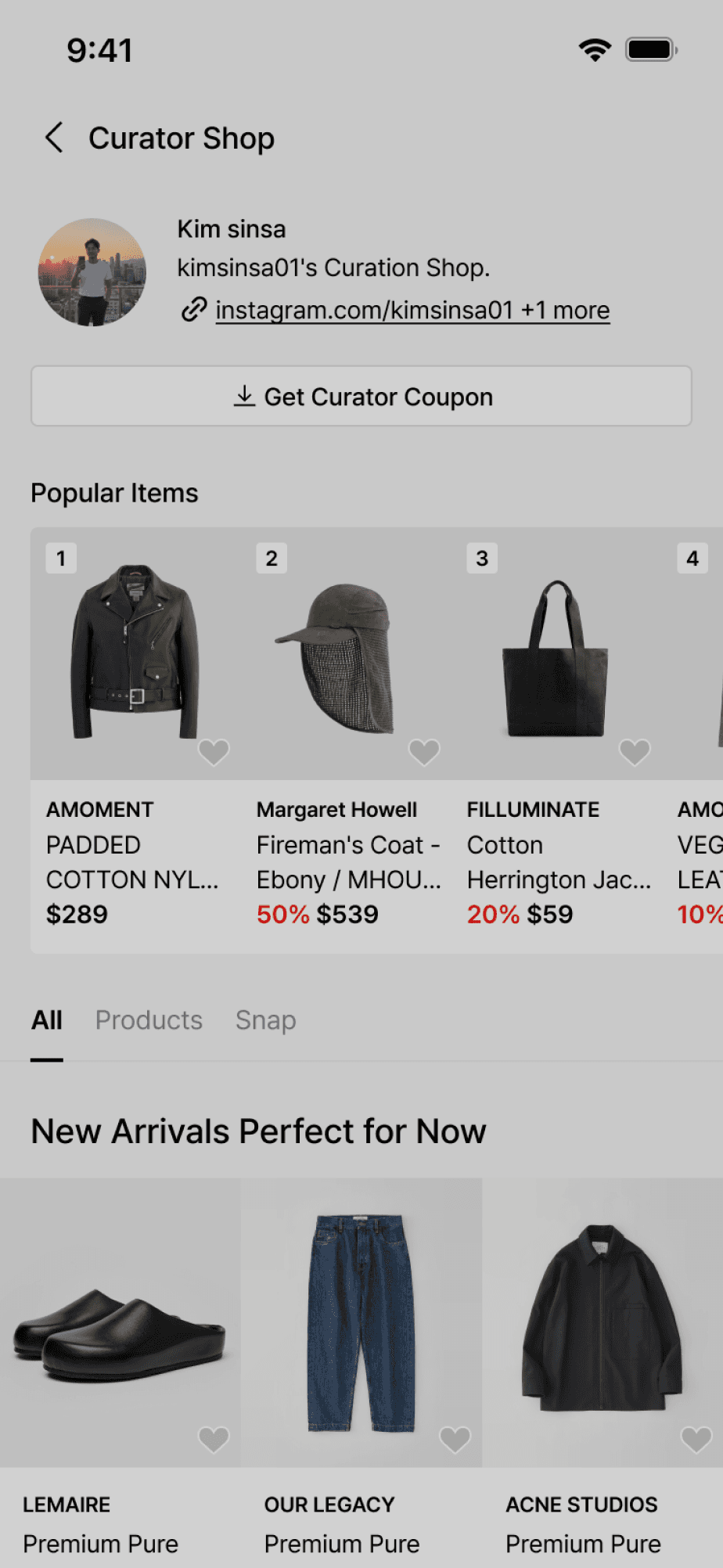
A coupon-box button in the curator shop's profile area, with different copy for the curator view and the customer view.
A coupon-box button in the curator shop's profile area, with different copy for the curator view and the customer view.




Design Decision
v.3
Visible,
but still a generic CTA
A secondary CTA balances visibility, but does not clearly communicate the coupon itself.
v.2
Prominent,
but visually dominant
A primary CTA improves visibility, but draws too much attention from the main content.
v.1
Compact,
but easy to miss
Compact, but easy to miss as a new coupon entry point.
Final
More recognizable
coupon entry point
The final design turns the entry point into a coupon-like UI improves
both recognition and visibility as
a new entry point.


02
Redesigning the claim flow
Redesigning the claim flow
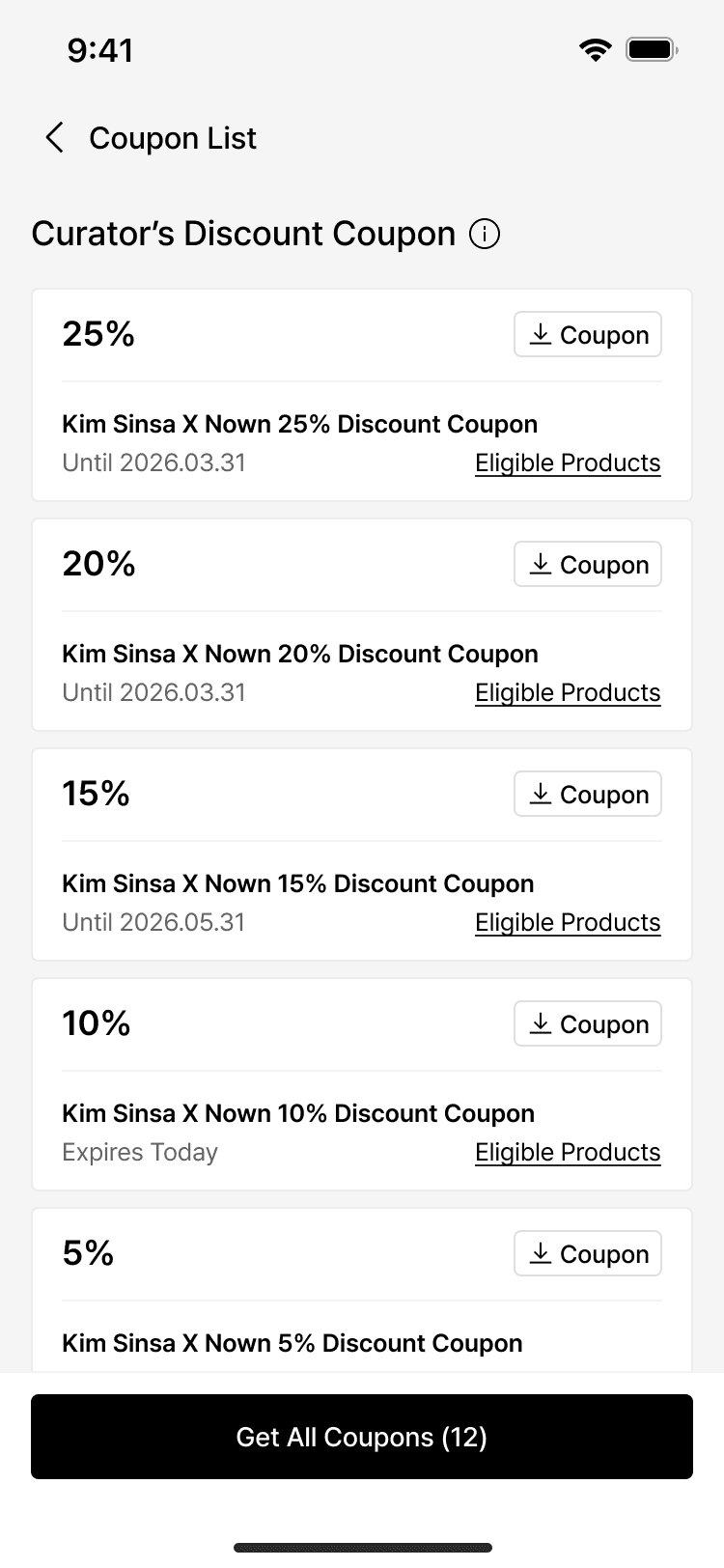
I compared the two flows by the in-app steps after the customer clicks the affiliate link.
I compared the two flows by the in-app steps after the customer clicks the affiliate link.
The fit is great, and since it’s wool
the fabric feels amazing too. Definitely recommend giving it a try. 🍁Don’t forget to check out the fall styling picks at Kim Sinsa’s Curator Shop!
Shop: www.musinsa.com/curator/shop/V0Byfa
Coupon code: VX1234


kim.sinsa
2026. 06. 01
#CuratorShop



Design Decision
A one-page flow that connects claim, browse, and buy
Curator content
(social post)
Go to MUSINSA
Curator Shop
via affiliate-link
Claim coupon
Browse
eligible items
Product
detailed page
Purchase
Purchase

Outcome
Outcome
Most customers now claim and buy without ever leaving the tracked path, with 91.3% landing there directly and 45.38% of coupon GMV flowing through it.
Most customers now claim and buy without ever leaving the tracked path, with 91.3% landing there directly and 45.38% of coupon GMV flowing through it.
Post-launch monitoring confirmed zero attribution leakage across all coupon transactions since launch. The 28% leak wasn't reduced through better tracking, it was closed structurally: once the claim path became inseparable from the browse-to-purchase journey, there was no longer a path for a customer to break off and bypass it.
Post-launch monitoring confirmed zero attribution leakage across all coupon transactions since launch. The 28% leak wasn't reduced through better tracking, it was closed structurally: once the claim path became inseparable from the browse-to-purchase journey, there was no longer a path for a customer to break off and bypass it.
Coupon Page Direct Visit
Coupon Page Direct Visit
91.3%
Customers reach the claim page without leaving the affiliate-link route, so the condition for holding attribution is working
Customers reach the claim page without leaving the affiliate-link route, so the condition for holding attribution is working
Coupon GMV Attribution
(up to 73.27%)
Coupon GMV Attribution
(up to 73.27%)
45.38%
bout half of coupon buyers went through the redesigned journey
bout half of coupon buyers went through the redesigned journey
Reflection ✨
At first glance, the attribution loss looked like a tracking or coupon-structure problem. What I took away is that the fix only lands if it's delivered through UX design that actually reaches the user.
The job isn't just diagnosing the structural cause, it's finding where the real customer experience breaks and designing to fix that. As a designer, I didn't solve this by adding new tracking technology. I solved it by rebuilding the flow so customers never leave the path they were already trying to take.
The other thing I confirmed: three simple principles, keeping the entry path intact, cutting steps, and staying consistent, ended up satisfying three different stakeholders at once, the customer, the curator, and the business. Good UX design usually comes down to finding the point where those different goals don't conflict.
At first glance, the attribution loss looked like a tracking or coupon-structure problem. What I took away is that the fix only lands if it's delivered through UX design that actually reaches the user.
The job isn't just diagnosing the structural cause, it's finding where the real customer experience breaks and designing to fix that. As a designer, I didn't solve this by adding new tracking technology. I solved it by rebuilding the flow so customers never leave the path they were already trying to take.
The other thing I confirmed: three simple principles, keeping the entry path intact, cutting steps, and staying consistent, ended up satisfying three different stakeholders at once, the customer, the curator, and the business. Good UX design usually comes down to finding the point where those different goals don't conflict.
← Previous