MUSINSA Ads Platform 2.0
Agency Center & BizMoney Payments (UX)
MUSINSA Ads Platform 2.0
Agency Center & BizMoney Payments (UX)
Rebuilt how agencies manage ad accounts and payments, cutting recharge lead time from 5.6 to 3 days and growing agency-driven ad revenue 7.83x.
Rebuilt how agencies manage ad accounts and payments, cutting recharge lead time from 5.6 to 3 days and growing agency-driven ad revenue 7.83x.
Platform
Web
My role
Product Designer
Timeline
February 2025 -
July 2025
Team
1 Product Manager
1 Front-End Engineer
2 Back-End Engineer
Overview
Overview
Rebuilt how agencies manage ad accounts and payments, growing agency-driven ad revenue 7.83x and cutting recharge lead time from 5.6 to 3 days.
Rebuilt how agencies manage ad accounts and payments, growing agency-driven ad revenue 7.83x and cutting recharge lead time from 5.6 to 3 days.
MUSINSA's Product Ads lets partners pay a fee, on top of their standard sales commission, to feature products in paid placements across the MUSINSA Store. The fee is also a revenue source for MUSINSA itself.
Many partners hand this work to agencies, who manage ad accounts and payments on their behalf. Ads Center 1.0 first turned Product Ads into an actual tool, but its limited functionality, including no direct way for agencies to log in, kept them from scaling ad operations. That gap pushed the team toward a full redesign.
MUSINSA's Product Ads lets partners pay a fee, on top of their standard sales commission, to feature products in paid placements across the MUSINSA Store. The fee is also a revenue source for MUSINSA itself.
Many partners hand this work to agencies, who manage ad accounts and payments on their behalf. Ads Center 1.0 first turned Product Ads into an actual tool, but its limited functionality, including no direct way for agencies to log in, kept them from scaling ad operations. That gap pushed the team toward a full redesign.
Impact
Impact
Growth in agency-driven
Ad revenue
Growth in agency-driven Ad revenue
7.83 x
Recharge lead time
5.6 → 3days
Ad account adoption
80%
Context
Context
Evolving the ads platform into a scalable product
Evolving the ads platform into a scalable product
MUSINSA is Korea’s leading fashion commerce platform (~5.3M MAU), offering paid merchandising solutions that help brands grow within its ecosystem. This Ads Platform project focused on evolving a validated ads platform into a scalable product—so it continues to perform reliably as advertiser volume and operational complexity increase.
MUSINSA is Korea’s leading fashion commerce platform (~5.3M MAU), offering paid merchandising solutions that help brands grow within its ecosystem. This Ads Platform project focused on evolving a validated ads platform into a scalable product—so it continues to perform reliably as advertiser volume and operational complexity increase.
Project Goal
Project Goal
Enable agency-led ad operations at scale with clear roles/permissions, while improving payments UX to reduce campaign downtime from delayed top-ups.
Enable agency-led ad operations at scale with clear roles/permissions, while improving payments UX to reduce campaign downtime from delayed top-ups.
* Product Ads placements
* Product Ads placements

Problems
Problems
Two structural constraints were capping growth of the advertising business.
Two structural constraints were capping growth of the advertising business.
Problem.1
Problem.1
Ads Platform 1.0 was built on top of MUSINSA's partner portal, which limited its scalability.
Ads Platform 1.0 was built on top of MUSINSA's partner portal, which limited its scalability.
Because the underlying system couldn't be accessed externally, advertising agencies and partners from other platforms (29CM, SOLDOUT, and others) had no way to use the Ads Center.
As the number of advertisers grew, so did the demand for agencies to manage campaigns on their behalf, but this structural limitation meant the platform couldn't meet that demand.
Because the underlying system couldn't be accessed externally, advertising agencies and partners from other platforms (29CM, SOLDOUT, and others) had no way to use the Ads Center.
As the number of advertisers grew, so did the demand for agencies to manage campaigns on their behalf, but this structural limitation meant the platform couldn't meet that demand.
MUSINSA Ads Platform
1.0
Agency
Users
External
Partners
Access Blaocked
Expected Business Impact
Expected Business Impact
Opening Product Ads to agencies would grow the partner base and unlock a new stream of annual ad revenue for MUSINSA.
Opening Product Ads to agencies would grow the partner base and unlock a new stream of annual ad revenue for MUSINSA.
Problem.2
Problem.2
When an ad budget ran out, there was no way to prevent campaigns from going inactive, breaking the continuity of ad delivery, and no automatic recharge feature existed to prevent this.
When an ad budget ran out, there was no way to prevent campaigns from going inactive, breaking the continuity of ad delivery, and no automatic recharge feature existed to prevent this.
Limited payment methods: the existing system supported only virtual account transfers.
Once a funded budget was depleted, recharging BizMoney through a virtual account (a manual process) introduced significant lead time, averaging 5.6 days as of April 2025.
Limited payment methods: the existing system supported only virtual account transfers.
Once a funded budget was depleted, recharging BizMoney through a virtual account (a manual process) introduced significant lead time, averaging 5.6 days as of April 2025.

Expected Business Impact
Expected Business Impact
A faster recharge process would keep campaigns running without interruption, protecting ad spend that used to get lost every time a budget ran out.
A faster recharge process would keep campaigns running without interruption, protecting ad spend that used to get lost every time a budget ran out.
UX Strategy
UX Strategy
A structure for reliably operating multiple accounts, paired with a clear campaign experience from payment to recharge.
A structure for reliably operating multiple accounts, paired with a clear campaign experience from payment to recharge.
Strategy 1
Strategy 1
Design a scalable multi-account structure so agencies and partners can operate multiple accounts efficiently.
Design a scalable multi-account structure so agencies and partners can operate multiple accounts efficiently.
01
Give agencies an efficient, intuitive way to manage multiple advertiser accounts.
01
Give agencies an efficient, intuitive way to manage multiple advertiser accounts.
02
Build a clear account management framework so agencies and partners can keep multiple accounts organized.
02
Build a clear account management framework so agencies and partners can keep multiple accounts organized.
03
Build a flexible, extensible structure that can accommodate multiple platforms as well as future ad products.
03
Build a flexible, extensible structure that can accommodate multiple platforms as well as future ad products.
Strategy 2
Strategy 2
Provide a stable, clear campaign experience across card registration, card management, and auto-recharge.
Provide a stable, clear campaign experience across card registration, card management, and auto-recharge.
01
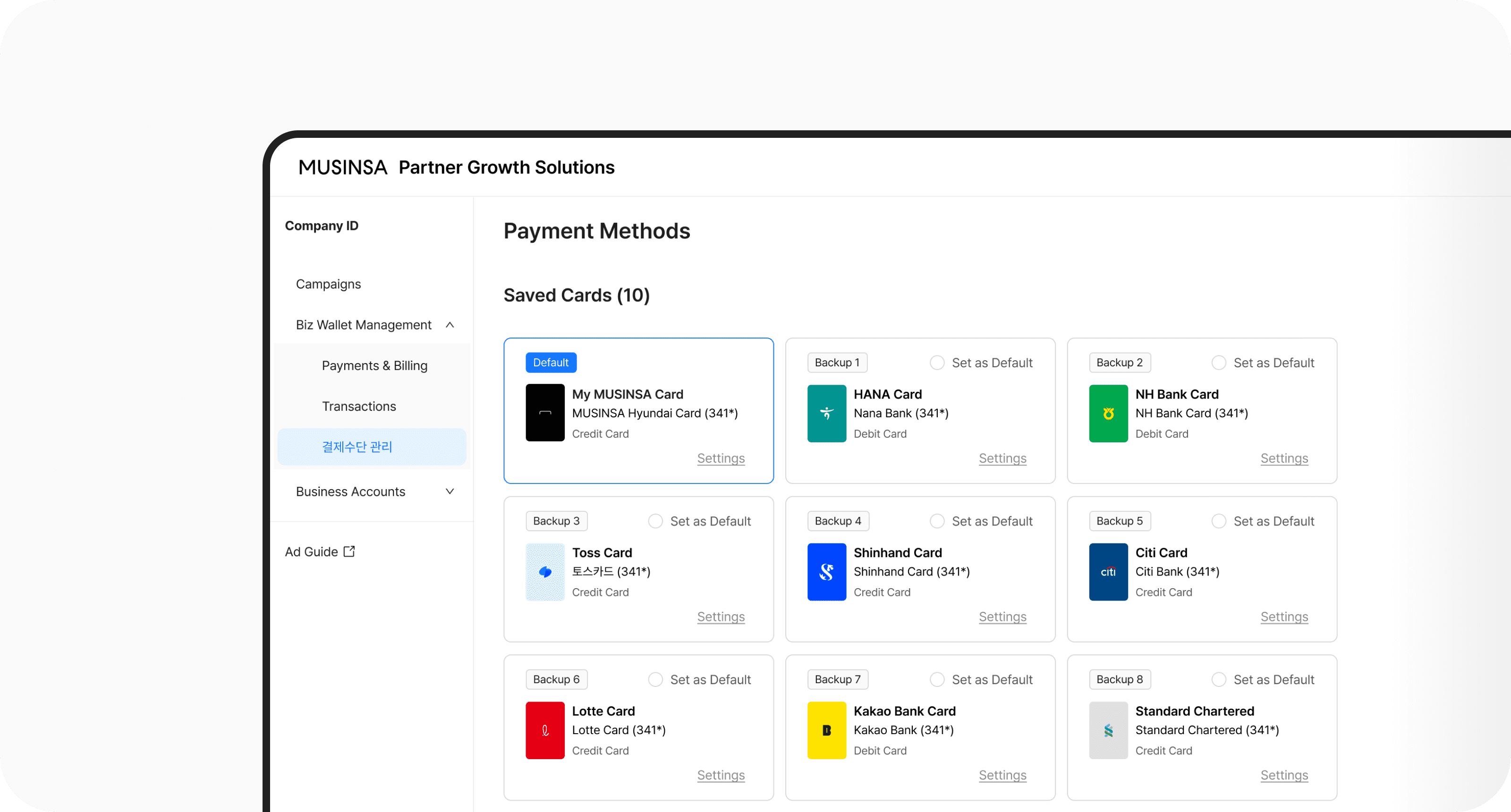
Make card registration simple, so users move through a consistent, predictable flow.
01
Make card registration simple, so users move through a consistent, predictable flow.
02
Let users see all registered cards at a glance and easily manage their default payment method.
02
Let users see all registered cards at a glance and easily manage their default payment method.
03
Give users a UI that makes auto-recharge rules clear to understand and easy to set up.
03
Give users a UI that makes auto-recharge rules clear to understand and easy to set up.
Solution
Solution
We built a new agency workflow and designed a payment system to keep campaigns running without interruption.
We built a new agency workflow and designed a payment system to keep campaigns running without interruption.
Solution 1
Solution 1
Separate the domain and build a dedicated agency system
Separate the domain and build a dedicated agency system


Split the Ads Center out from the partner platform, with separate entry points for advertisers and agencies.
Design an agency sign-up and verification process.

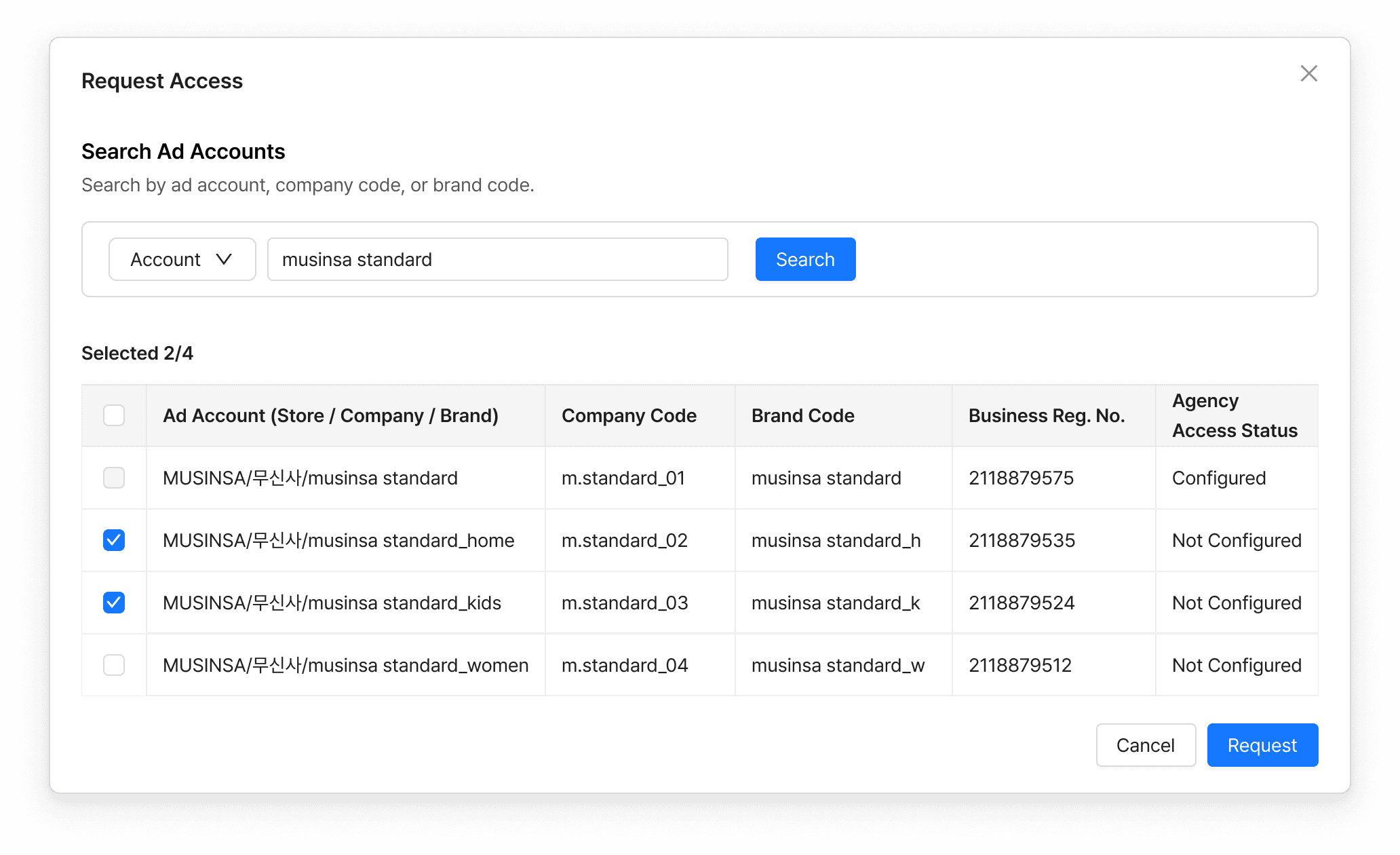
Manage permissions: access requests, approvals, and administration.
Role-based navigation and an extensible IA for multi-account operation.

Split the Ads Center out from the partner platform, with separate entry points for advertisers and agencies.
Design an agency sign-up and verification process.

Solution 2
Solution 2
Support BizMoney auto-recharge and card payments
Support BizMoney auto-recharge and card payments


BEFORE


AFTER


Support card payments, with multi-card management and a default payment method.
Set auto-recharge rules per ad account.
Improve budget visibility and streamline the on-demand recharge flow.

Outcomes
Outcomes
Scaling up agency-led operations and improving payment continuity cut recharge time by 47% and grew agency-driven paid ad revenue 7.83x.
(4 months after payments rollout)
Scaling up agency-led operations and improving payment continuity cut recharge time by 47% and grew agency-driven
paid ad revenue 7.83x.
(4 months after payments rollout)
7.83 x
7.83 x
Growth
Growth
A Real Expansion of the Ad Revenue Model
A Real Expansion of the Ad Revenue Model
A real expansion of the ad revenue model. Paid ad revenue through agencies grew 7.83x (a 683% increase) compared to the month before rollout, and more than half of all brands running agency-managed campaigns adopted paid ads.
A real expansion of the ad revenue model. Paid ad revenue through agencies grew 7.83x (a 683% increase) compared to the month before rollout, and more than half of all brands running agency-managed campaigns adopted paid ads.
80% ✓
80% ✓
Ad Account Adoption Rate
Ad Account Adoption Rate
Successful Rollout of Card Payments
Successful Rollout of Card Payments
Successful rollout of the card payment flow. Credit card payments accounted for 80% of all ad accounts, and card payments made up 76% of total recharge volume.
5.6 → 3days
5.6 → 3days
Recharge Lead Time
Recharge Lead Time
Stronger Campaign Continuity, Proven Auto-Recharge
Stronger Campaign Continuity, Proven Auto-Recharge
Stronger campaign continuity, and proof that auto-recharge works. Fewer campaigns went inactive due to insufficient balance, and the average delay before recharging after running low dropped from 5.6 days to under 3 days.
Stronger campaign continuity, and proof that auto-recharge works. Fewer campaigns went inactive due to insufficient balance, and the average delay before recharging after running low dropped from 5.6 days to under 3 days.