Personalizing TMON's Main Home
Personalizing TMON's Main Home
Validated personalized recommendation logic for TMON’s main home feed, proving stronger performance than manual curation through staged testing with BytePlus Singapore.
Validated personalized recommendation logic for TMON’s main home feed, proving stronger performance than manual curation through staged testing with BytePlus Singapore.

Platform
PC/Mobile
My role
Product Owner
Timeline
May 2022 -
July 2022
Team
1 Product Owner (me)
1 Back-End Engineer
BytePlus ML team
Overview
Overview
This is the one non-design project in my portfolio, I include it because the experimentation skills I built as a PO shape how I design and validate today.
TMON, one of South Korea’s major mobile commerce platforms, operated its main home feed, one of the app’s highest-traffic entry points, through manual curation. As Product Owner, I led a cross-border initiative with BytePlus Singapore to validate whether personalized recommendation logic could improve performance on this critical surface.
I structured the validation into three stages: whitelist testing, load testing, and A/B testing. The test results showed that personalized recommendations outperformed manual curation, validating the product direction before the project was discontinued due to company-level acquisition changes. Through this project, I expanded my PO scope from product planning and technical validation to commercial stakeholder alignment.
This is the one non-design project in my portfolio, I include it because the experimentation skills I built as a PO shape how I design and validate today.
TMON, one of South Korea’s major mobile commerce platforms, operated its main home feed, one of the app’s highest-traffic entry points, through manual curation. As Product Owner, I led a cross-border initiative with BytePlus Singapore to validate whether personalized recommendation logic could improve performance on this critical surface.
I structured the validation into three stages: whitelist testing, load testing, and A/B testing. The test results showed that personalized recommendations outperformed manual curation, validating the product direction before the project was discontinued due to company-level acquisition changes. Through this project, I expanded my PO scope from product planning and technical validation to commercial stakeholder alignment.
Summary
Summary
Problem
TMON’s main home relied on manual curation, which limited scalability as the product catalog and user segments grew.
Approach
Led a cross-border product validation process with BytePlus Singapore, structuring the rollout into whitelist testing, load testing, and A/B testing.
Outcome
The recommendation logic outperformed manual curation in the A/B test, validating the product direction before the project was discontinued due to company-level acquisition changes.
Context & Problem
Context & Problem
TMON’s main home was one of the most important traffic entry points in the app, but its feed relied heavily on manual curation.
TMON’s main home was one of the most important traffic entry points in the app, but its feed relied heavily on manual curation.
The problem I identified
The problem I identified
Problem.1
Problem.1
The main feed consisted of around 100 manually curated slots, making it difficult to reflect individual user intent at scale.
The main feed consisted of around 100 manually curated slots, making it difficult to reflect individual user intent at scale.
Problem.2
Problem.2
As the product catalog grew to hundreds of thousands of SKUs, manual selection created operational limits for merchandisers.
As the product catalog grew to hundreds of thousands of SKUs, manual selection created operational limits for merchandisers.
Problem.3
Problem.3
Competitors were already moving toward personalization, raising user expectations for more relevant discovery experiences.
Competitors were already moving toward personalization, raising user expectations for more relevant discovery experiences.
Why this mattered
Why this mattered
Because the main home influenced a significant share of product discovery and GMV, even a modest lift in CTR or CVR could create meaningful business impact.
Because the main home influenced a significant share of product discovery and GMV, even a modest lift in CTR or CVR could create meaningful business impact.
Process: 3-Stage Validation Framework
Process: 3-Stage Validation Framework
To reduce the risk of introducing an external recommendation system directly into a high-traffic surface, I designed a staged validation framework.
To reduce the risk of introducing an external recommendation system directly into a high-traffic surface, I designed a staged validation framework.
Why three stages?
Why three stages?
Introducing an external recommendation system for the first time carried product, technical, and operational risks. Each stage acted as a gate for the next.
Introducing an external recommendation system for the first time carried product, technical, and operational risks. Each stage acted as a gate for the next.
Stage.1
Whitelist Test
Internal employees, sanity check on recommendation quality.
Internal employees, sanity check on recommendation quality.
Stage.2
Load Test
Production traffic simulation, latency & stability validation
Production traffic simulation, latency & stability validation
Stage.3
A/B Test (Dev)
Statistical comparison: Manual curation vs. ML
Statistical comparison: Manual curation vs. ML
A/B Test — Key experiment design decisions
A/B Test — Key experiment design decisions
Hypothesis
Hypothesis
Manual curation can work for broad, average-user merchandising, but personalized recommendation logic would perform better by reflecting individual user intent.
Manual curation can work for broad, average-user merchandising, but personalized recommendation logic would perform better by reflecting individual user intent.
Metrics
Metrics
Primary metric: CTR
Secondary metrics: CVR, time-to-purchase
Guardrails: Page latency, GMV concentration, category diversity
Primary metric: CTR
Secondary metrics: CVR, time-to-purchase
Guardrails: Page latency, GMV concentration, category diversity
✓ Decision rule
Together with stakeholders, we pre-defined that a primary metric win alone would not be enough for launch. The recommendation logic also had to stay within acceptable guardrail ranges, especially around latency and business diversity.
Together with stakeholders, we pre-defined that a primary metric win alone would not be enough for launch. The recommendation logic also had to stay within acceptable guardrail ranges, especially around latency and business diversity.
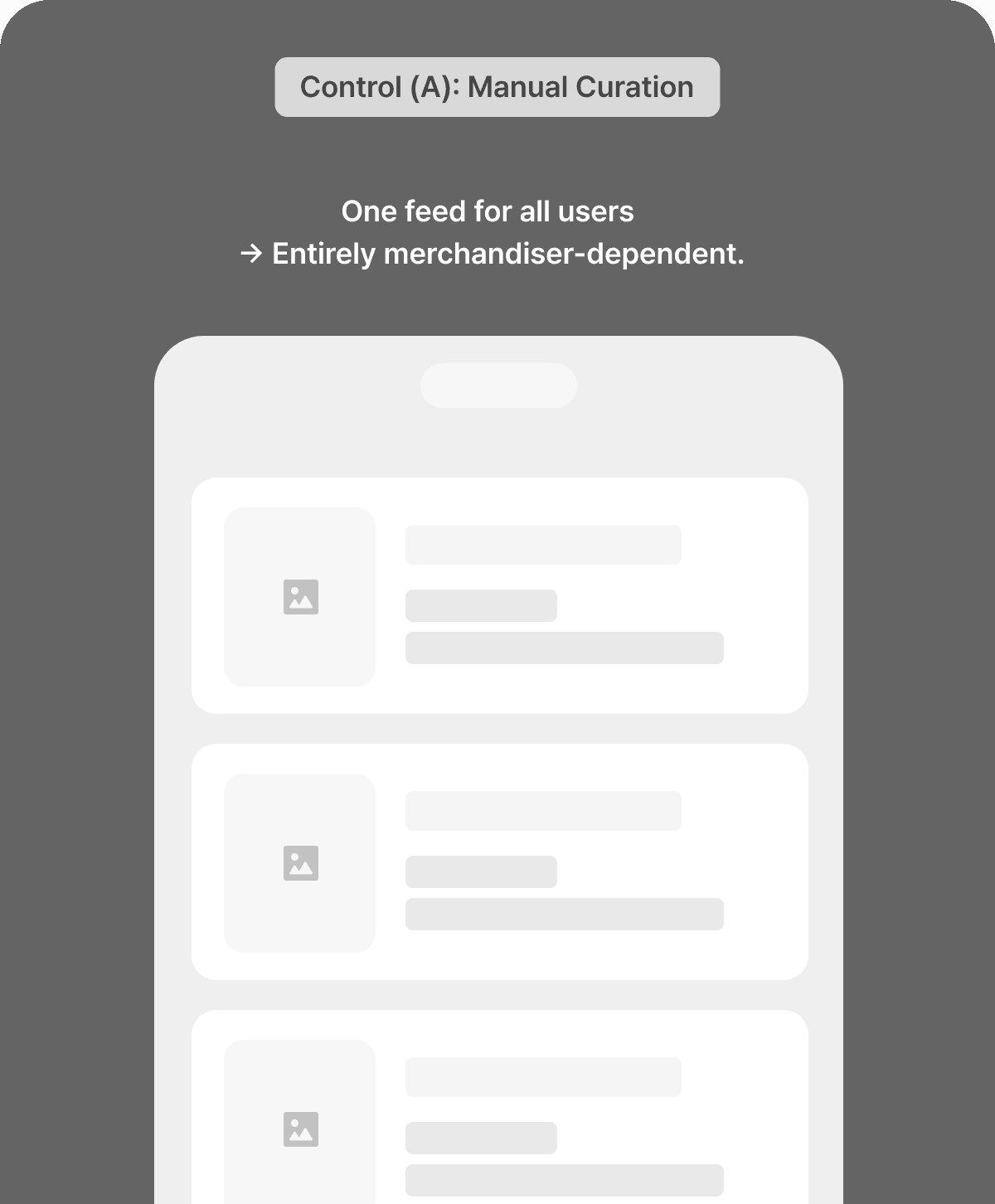

Control (A): Manual Curation
One feed for all users
→ Entirely merchandiser-dependent.
Treatment (B): ML Recommendation

Personalized for me!



Outcome
Outcome
The A/B test showed that personalized recommendation logic outperformed manual curation, validating the business potential of applying personalization to TMON’s main home feed.
Although the project was discontinued before master contract signing due to company-level acquisition changes, the validation process confirmed that the recommendation approach had stronger performance potential than the existing manual curation model.
The A/B test showed that personalized recommendation logic outperformed manual curation, validating the business potential of applying personalization to TMON’s main home feed.
Although the project was discontinued before master contract signing due to company-level acquisition changes, the validation process confirmed that the recommendation approach had stronger performance potential than the existing manual curation model.
Learning
Learning
What I took from this The project ended before contract signing due to the company's acquisition, but the staged validation framework — whitelist, load, A/B — became how I approach risk in every launch since. It also taught me that a clear pre-agreed decision rule matters more than a winning metric: it's what kept stakeholders aligned when the project's future became uncertain.

Learning
Learning
What I took from this The project ended before contract signing due to the company's acquisition, but the staged validation framework — whitelist, load, A/B — became how I approach risk in every launch since. It also taught me that a clear pre-agreed decision rule matters more than a winning metric: it's what kept stakeholders aligned when the project's future became uncertain.